Costs and pricing
Part of Planning the creative-software cost stack, from charging unit to exit provision
A creative-tool budget template that traces every pound from licence fee to exit
Create a traceable creative-tool budget with blank inputs for licences, usage, staff effort, assurance, contingency, tax and exit scenarios.
Build the workbook so a reviewer can trace every number back to a document or observation. The structure below contains no sample prices by design. Invented values tend to survive copying and acquire false authority.
Each tab carries one illustrative row of placeholder figures, so the formulas can be traced; clearing those values leaves a blank table ready to copy.
What to take away
- Build the workbook so a reviewer can trace every number back to a document or observation.
- Finance must set the loading policy for labour costs, not a single percentage across all salaries.
- Ask a qualified tax adviser to approve the tax treatment and recoverability assumptions.
Tab 1: scope and control
Record the decision owner, business objective, England or wider geography, contract period, currencies and proposed use. Add the brands, users, outputs, placements, data classes and integrations inside the boundary. Put excluded functions and information beside them.
Scope and control inputs
- Decision owner and business objective
- England or wider geography
- Contract period and currencies
- Brands, users, outputs, placements
- Data classes and integrations
- Excluded functions and information
- Citation ID, access date, owner
Give each input a citation ID, access date, effective period and owner. Supporting material might be a supplier quote, contract schedule, payroll record, time observation or tax opinion. Add a confidence label and the event that would invalidate it.
Illustrative row (placeholder figures):
| Objective | Geography | Contract term | Users | Currencies | Citation ID | Owner |
|---|---|---|---|---|---|---|
| Brand campaign | England | 12 months | 25 named seats | GBP | S-01 | Marketing lead |
Tab 2: supplier cash flow
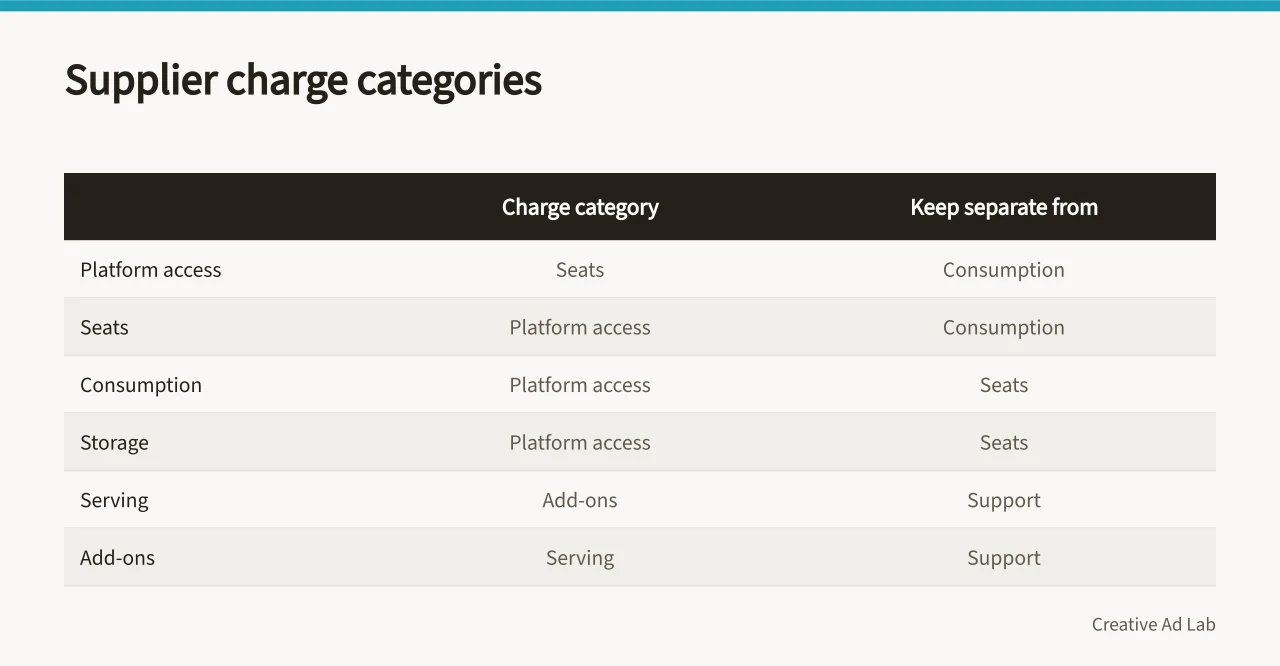
Create one row per charge, with columns for unit, quantity, rate, tax basis, billing date, commitment, escalation rule and citation ID. Keep platform access, seats, consumption, storage, serving, add-ons, support and professional services distinct.
The calculation for a period is:
supplier cash = fixed charges + sum of (billable quantity x applicable rate) + one-off services + tax payable
Do not merge a discount into the rate. Give it a row with its conditions and expiry so the renewal view does not inherit it accidentally.
Illustrative row (placeholder figures):
| Charge | Unit | Quantity | Rate | 12 month total | Tax basis | Citation ID |
|---|---|---|---|---|---|---|
| Seats | seat per month | 25 | £10 placeholder | £3,000 | 20% VAT | S-02 |
For UK licence and seat benchmarks, the Crown Commercial Service publishes G-Cloud supplier listings and price lists. Each listing states its framework period, so an effective date travels with the figure. Vendor price pages and the buyer's own invoice history are the other places to check.
Tab 3: buyer-side effort
List discovery, procurement, security assessment, contract review, migration, template creation, training, administration, quality assurance and measurement. For each task, enter a role, measured or estimated hours, loaded hourly cost, evidence and uncertainty range.
Buyer-side effort tasks
- Discovery
- Procurement
- Security assessment
- Contract review
- Migration
- Template creation
- Training
- Admin, QA and measurement
Use labour cost = sum of (task hours x approved loaded hourly cost). Finance must set the loading policy. HMRC's current National Insurance rates apply thresholds and categories, so a single percentage pasted across all salaries would be misleading. The cited page was updated for the 2026 to 2027 tax year on 6 April 2026.
Illustrative row (placeholder figures):
| Task | Role | Hours | Loaded hourly cost | Uncertainty range | Evidence |
|---|---|---|---|---|---|
| Training | Studio manager | 12 | £40 placeholder | £360 to £600 | Time log |
Tab 4: tax and accounting treatment
For each cash item, include the VAT rate used, recoverability assumption and timing. When this template was prepared on 5 September 2026, GOV.UK listed 20% as the standard VAT rate for most goods and services. That public rate does not decide whether a specific invoice carries UK VAT or whether this buyer can reclaim it.
Show gross cash, expected recoverable tax and net cost in separate columns. Ask a qualified tax adviser to approve the treatment. Finance should also decide whether accounting recognition differs from cash timing.
Illustrative row (placeholder figures):
| Item | Gross cash | Recoverable tax | Net cost | Timing |
|---|---|---|---|---|
| Seats and migration | £3,600 | £600 placeholder | £3,000 | Same quarter as the cash |
Tab 5: scenarios and reserves
Copy the verified inputs into low, central and high cases. Vary only quantities or rates with a stated reason, such as user growth, usage fluctuation, currency movement or a delayed rollout. Do not change several assumptions inside one unexplained percentage.
Add risk rows with an owner, trigger, response and cost consequence. HM Treasury's Green Book 2026 requires public appraisals to address risks, uncertainty and optimism bias, and its sensitivity analysis call is worth copying for private buyers even though it does not govern them.
Illustrative row (placeholder figures):
| Case | Driver changed | Seat line | Owner | Trigger | Response |
|---|---|---|---|---|---|
| High | 20% user growth | £3,600 | Marketing lead | Second region rollout | Bring the review forward |
Tab 6: renewal and exit
Forecast asset export, archive, replacement procurement, retraining, integration removal and reconstruction. Identify anything the buyer has not proved it can retrieve. Link each departure task to a contract clause or trial result.
Illustrative row (placeholder figures):
| Exit task | Hours | Loaded hourly cost | Cost | Contract link | Retrieval proved |
|---|---|---|---|---|---|
| Asset export | 8 | £40 placeholder | £320 | Exit clause | Trial export |
Finish with approval cells for finance, commercial, security, privacy and tax reviewers, including comments and dates. The workbook should fail closed: missing evidence remains blank and prevents a confident total, rather than being replaced by a convenient guess.
Protect the workbook as a decision record. Restrict editing of formula cells, retain version history and store quoted documents with access controls appropriate to their contents. At renewal, duplicate the approved version before changing inputs so the team can explain why the later forecast moved.
Before you act
- Record decision owner, objective, geography, contract period and currencies.
- Give each input a citation ID, access date, effective period and owner.
- Keep platform access, seats, consumption and storage distinct from serving and add-ons.
- List buyer-side tasks with role, hours, loaded hourly cost and evidence.
- Show gross cash, expected recoverable tax and net cost in separate columns.
- Protect the workbook, restrict formula editing and retain version history.
Common questions
Why is a single National Insurance percentage across all salaries misleading?
HMRC's current National Insurance rates apply thresholds and categories. A single percentage pasted across all salaries would ignore these thresholds and categories. Finance must set the loading policy, and the cited page was updated for the 2026 to 2027 tax year on 6 April 2026.