Costs and pricing
Part of Planning the creative-software cost stack, from charging unit to exit provision
Seat, usage, serving or custom: how creative platform pricing really behaves
Creative platform pricing compared across seat, usage, serving and custom charges, without hiding commitments, limits, overages or scope gaps.
Two proposals cannot be compared by headline fee when they meter different things. One may charge for named users, another for creative volume, and a third for media delivery.
What to take away
- Translate each pricing model into the buyer's expected activity before comparing headline fees.
- Seat-based charging suits stable user populations but can encourage shared accounts or excessive administration.
- Usage and serving models require clear definitions of billable events and reconciliation routes.
- Custom proposals need a comparable schedule separating mandatory access, modules, support, usage and exit.
- Compare low, expected and high volumes, and show non-comparable items beside totals.
Comparison method
This desk comparison covers charging structures visible in supplier material or commonly presented in proposals. Most creative platforms do not publish list prices, so the comparison maps those structures and uses illustrative figures only. It does not rank products. Supplier evidence was checked on 5 September 2026; England contract terms and tax treatment require a current written offer.
Pricing models and risk questions
Model
- Seat or licence
- Named and occasional users
- Output or usage
- Assets, renders, exports
- Serving
- Impressions, video starts
- Platform plus add-ons
- Base scope and modules
- Custom commitment
- Minimum, term, scaling bands
Buyer input
- Seat or licence
- Lighter entitlement for reviewers?
- Output or usage
- What consumes a unit?
- Serving
- Which traffic is billable?
- Platform plus add-ons
- Essential workflow outside base?
- Custom commitment
- Volume falls or rises?
Risk question
- Seat or licence
- Output or usage
- Serving
- Platform plus add-ons
- Custom commitment
Use these fields for every candidate:
Input the buyer must supply
- Seat or licence (Creatopy)
- Named and occasional users by role
- Output or usage (AdCreative.ai)
- Defined assets, renders, variants or exports
- Serving (Celtra)
- Impressions, video starts or another delivery measure
- Platform plus add-ons (Celtra)
- Base scope and required modules
- Custom commitment (Celtra)
- Agreed minimum, term and scaling bands
Question that exposes risk
- Seat or licence (Creatopy)
- Can reviewers or agencies use a lighter entitlement?
- Output or usage (AdCreative.ai)
- What action consumes a unit, including failed work?
- Serving (Celtra)
- Which traffic is billable and how are disputes resolved?
- Platform plus add-ons (Celtra)
- Which essential workflow sits outside the base agreement?
- Custom commitment (Celtra)
- What happens when actual volume falls or rises?
Blank cells are more honest than guessed demand.
Creatopy publishes seat-based tiers, AdCreative.ai publishes credit-based plans, and Celtra quotes bespoke serving packages.
Seat-based charging
A licence model can be predictable where the user population is stable. It can also encourage shared accounts or excessive administrator work if occasional reviewers need full seats. Ask whether agencies, freelancers, approvers and service accounts count, and how reassignment works during staff changes.
Seat charge calculation
- Seat typeone input in the sum
- Contracted unit rateprice per seat
- Billed periodsnumber of periods charged
- Onboarding and permissionskept outside the expression
Calculate annual seat charge = sum of (seat type x contracted unit rate x billed periods). Keep onboarding and permission administration outside that expression so they remain visible.
Usage and serving measures
Usage aligns part of the charge with activity, but the contract must define the event. An export, generated variant, language version, storage operation and API request are different possible meters. Request a sample usage report and a reconciliation route.
Usage and serving reconciliation
- Define the billable event
- Request a sample usage report
- Agree a reconciliation route
- Model committed amount plus excess
- Reproduce supplier tiers exactly
Serving shifts attention from production to delivery. Celtra's current pricing page says its bespoke package depends on platform, scale and add-ons, and that ad-serving charges use impressions and/or video starts. This is one supplier's first-party description, not evidence that the structure is economical or that the stated support fits a particular buyer.
For a volume band, model charge = committed amount + eligible excess units x overage rate. If the supplier uses tiers, reproduce its calculation exactly rather than multiplying an average rate.
Custom proposals
A quote-led model is not inherently opaque, but it needs a comparable schedule. Ask each bidder to separate mandatory platform access, modules, integrations, implementation, support, usage, renewal and exit assistance. Record minimum commitments and the conditions attached to any discount.
Custom proposal schedule
- Separate mandatory platform access
- List modules and integrations
- Price implementation and support
- State usage and renewal terms
- Record minimum commitments
- Note discount conditions
- Include exit assistance
The GOV.UK guidance on commercial off-the-shelf products advises understanding the need before commitment. For pricing comparison, ask each bidder to show how their custom schedule maps to that need.
Compare scenarios, not promises
Enter the same low, expected and high operational volumes for each proposal. Show non-comparable items beside the totals. If one supplier includes serving and another stops at exported files, the difference reflects scope as well as price.
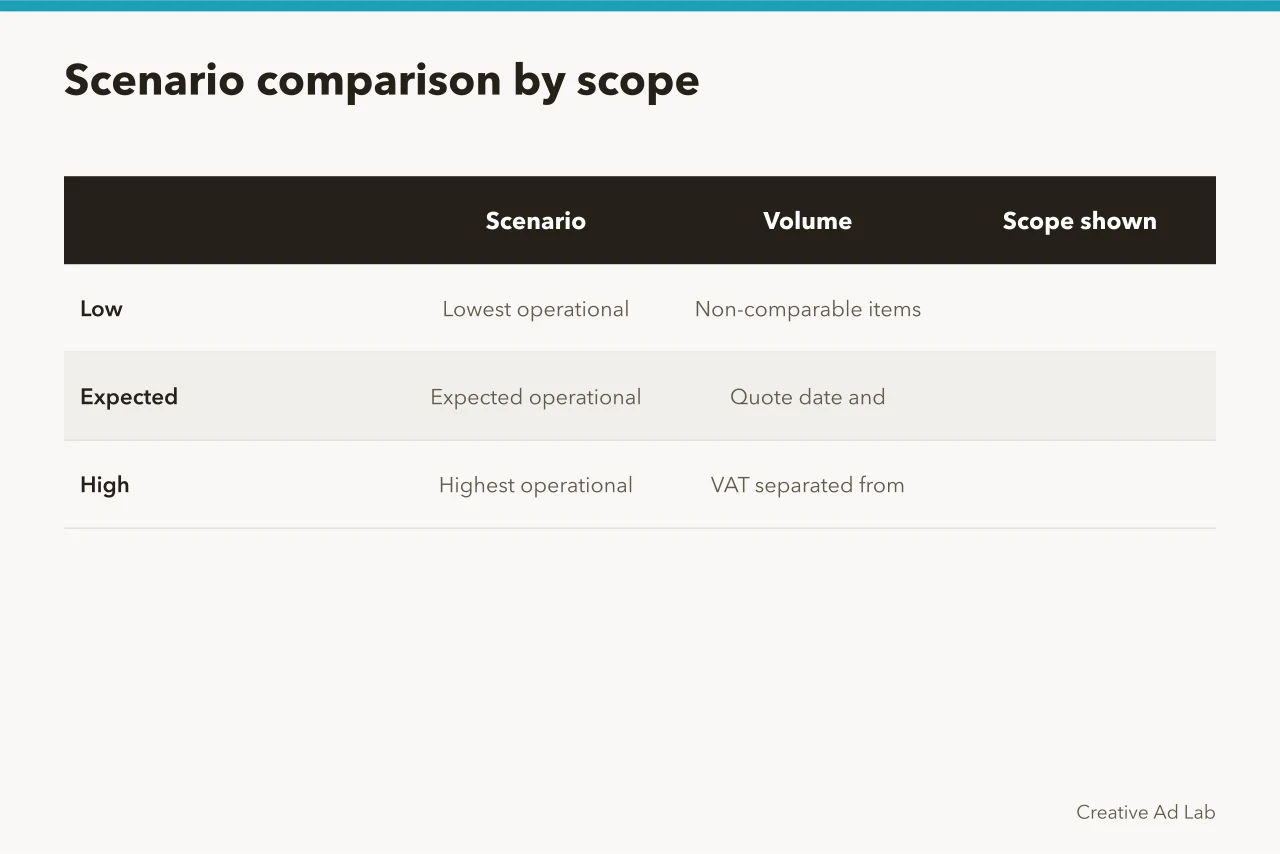
Use the same volumes for each proposal. The table below shows illustrative rates for method only; it is not a quote and does not reflect any named supplier. Seat rate: £40 per user per month. Usage rate: £0.02 per export. Serving rate: £0.50 per thousand impressions.
| Scenario | Seats | Exports | Impressions | Seat total | Usage total | Serving total | Combined total |
|---|---|---|---|---|---|---|---|
| Low | 10 | 5,000 | 2,000,000 | £4,800 | £100 | £1,000 | £5,900 |
| Expected | 20 | 20,000 | 10,000,000 | £9,600 | £400 | £5,000 | £15,000 |
| High | 40 | 50,000 | 30,000,000 | £19,200 | £1,000 | £15,000 | £35,200 |
State the quote date and validity period. Separate VAT from the underlying charge and send the treatment to a tax reviewer. A commercial reviewer should examine indexation, currency conversion, audit rights, renewal, overage and termination. The chosen model should match controllable demand, not simply produce the smallest central estimate.
Before you act
- Translate each offer into expected buyer activity.
- Define the billable event for usage or serving.
- Request sample usage reports and reconciliation routes.
- Separate mandatory platform access from add-ons.
- Model low, expected and high operational volumes.
Common questions
How should a buyer compare seat-based and usage-based pricing?
Seat-based charging can be predictable for stable user populations but may encourage shared accounts or excessive administration. Usage aligns part of the charge with activity, but the contract must define the billable event, such as an export or API request.
What should a buyer check in a custom proposal?
Ask each bidder to separate mandatory platform access, modules, integrations and support. Also separate implementation, usage, renewal and exit assistance. Record minimum commitments and the conditions attached to any discount. The GOV.UK guidance advises understanding the need and trying products before commitment, a discipline private buyers can borrow.
Why is a reconciliation owner needed before signature?
A reconciliation owner needs access to supplier usage records, internal demand data and the contractual definition of a billable event. Agree how discrepancies are raised and which record prevails. A charging structure that cannot be checked after invoicing is not yet controllable, so this role helps ensure the model matches controllable demand.